When you're running a business, hitting a cash flow crunch is more than just frustrating—it can feel like hitting a brick wall. This is especially true when you turn to a traditional bank only to find their process moves at a snail's pace. It's in these moments that alternative business loans have become a game-changer for so many entrepreneurs. They offer a lifeline of fast, flexible capital from non-bank lenders, stepping in when conventional options are just too slow or out of reach.
What Are Alternative Business Loans and Why Do They Matter
Think of a traditional bank loan like a highly specialized surgical tool. It's perfect for a very specific job, but only under ideal conditions. You need a spotless credit history, piles of documentation, and the patience to wait weeks—or even months—for an answer. For most small and mid-sized businesses, that timeline just doesn't work. The speed of business today is simply too fast.
Alternative business loans, on the other hand, are more like a versatile multi-tool. They're designed to handle the real-world, often messy, challenges you face every day. Need to cover an unexpected payroll gap? Want to jump on a great deal for bulk inventory? Have to finance a new piece of equipment to land a bigger contract? These funding options give you the agility to make decisive moves right when you need to.
The Shift Away From Traditional Banking
It’s no surprise that the business world has caught on. We're seeing a massive shift in how businesses get funded, with more and more owners looking past the big banks. This isn't just a fleeting trend; it's a fundamental change in business financing. The numbers speak for themselves: a staggering 72% of small businesses now go directly to non-bank lenders for credit instead of traditional banks. You can discover more about this market pivot and see projections showing the alternative lending market soaring to USD 105.3 billion by 2029.
So, what's driving this migration? It boils down to a simple reality: alternative lenders see businesses differently. Instead of getting bogged down in years of financial statements and perfect credit scores, they look at more current, practical indicators of your company's health.
- Real-Time Cash Flow: They're interested in the money moving through your accounts day-to-day, which gives them an immediate snapshot of your business's stability.
- Time in Business: Many only require a business to be operational for a year, opening up opportunities for newer companies that banks would typically turn away.
- Industry Know-How: These lenders get the seasonal ups and downs of industries like construction, retail, or trucking and build that understanding into their decision-making.
An alternative business loan isn't just a plan B; it's a strategic tool for growth. It empowers business owners to say "yes" to opportunities that would otherwise be missed while waiting for a bank's approval.
At the end of the day, the rise of alternative lending is a direct response to a market that demands faster, more accessible capital. For a growing wave of entrepreneurs, this kind of funding is no longer the last resort. It's become a primary strategic advantage for managing cash flow, fueling growth, and staying competitive when the traditional path is either too slow or completely blocked.
Navigating the Different Types of Alternative Business Loans
Getting a handle on your funding options is the first real step toward making a smart financial decision for your company. The world of alternative business loans isn't a one-size-fits-all solution; it's a diverse toolkit, with each tool designed to solve a specific business challenge. Instead of just rattling off definitions, let's dig into how these products actually work in the real world.
Think of alternative loans as a versatile connector, linking traditional resources like banks and investors with your ultimate goal: real, sustainable growth.
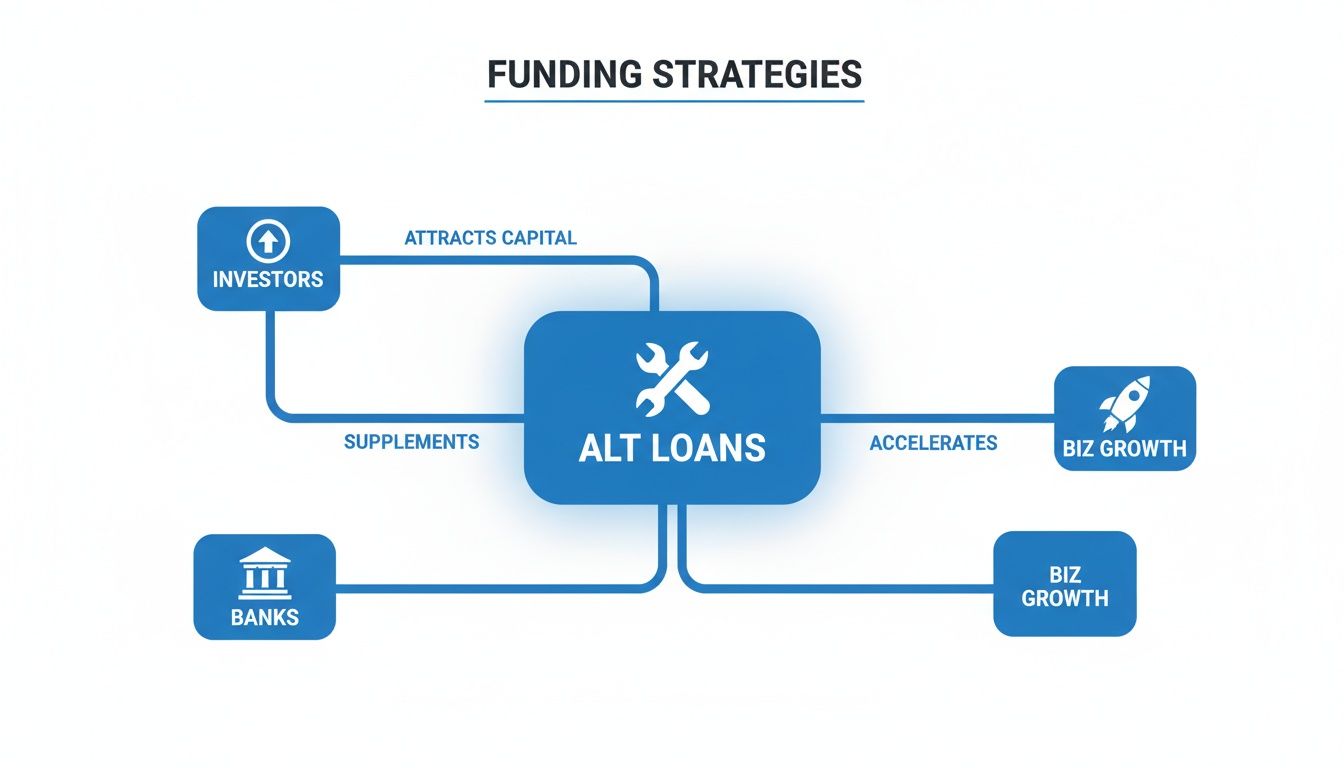
This isn't about replacing other financial tools. It's about adding a central component that creates momentum and turns growth plans into reality.
H3: Working Capital Loans for Immediate Needs
A working capital loan is probably the most straightforward option out there. It’s a lump sum of cash designed to cover your day-to-day operational expenses. This is your go-to for managing the short-term financial rhythm of your business, not for long-term investments like buying a building.
Imagine a local retail boutique needing $30,000 in inventory for the holiday rush. They know sales will be strong, but the cash simply isn't there right now to stock the shelves. A working capital loan provides the funds immediately, letting them seize that seasonal demand without draining their bank account.
These loans are incredibly versatile. You can use them for just about any short-term need:
- Making Payroll: Covering wages during a slow month is a classic use case.
- Marketing Campaigns: Funding a new advertising push to get customers in the door.
- Inventory Purchases: Stocking up before a predictable busy season.
- Unexpected Repairs: Paying for a critical piece of equipment that suddenly fails.
Repayment is typically structured over a short term. You’ll often see fixed daily or weekly payments automatically withdrawn from your business account, which makes budgeting predictable.
H3: Equipment Financing for Growth Assets
When your business needs a specific piece of machinery, technology, or equipment to operate or expand, equipment financing is tailor-made for the job. Instead of draining your cash reserves to pay the full price upfront, this loan covers the cost of the asset itself.
The best part? The equipment you're buying serves as collateral for the loan. This built-in security often makes these loans much easier to get approved for. If the business were to default, the lender’s recourse is to repossess the equipment, not go after your other assets.
Think about a construction company that just landed a huge contract but needs a new $150,000 excavator to do the work. Spending that much cash would put the business in a risky spot. With equipment financing, they get the excavator now and make manageable monthly payments over several years.
This structure allows the new asset to start generating revenue while it's being paid for—a true self-funding investment in your company's future.
H3: Revolving Lines of Credit for Ongoing Flexibility
A revolving line of credit works a lot like a business credit card, but usually with better terms and much higher limits. You get approved for a set amount of capital that you can draw from whenever you need it. You pay it back, and the full amount becomes available to you again.
Crucially, you only pay interest on the funds you’re actively using. This makes it the perfect tool for managing unpredictable expenses or bridging those inevitable cash flow gaps.
A home services company, for example, might have wildly different costs for materials and labor from month to month. A line of credit acts as a financial safety net. They can draw funds to buy supplies for a big job, then repay the balance as soon as the client’s invoice is paid. They never have to turn down work just because of a temporary cash crunch.
H3: Merchant Cash Advances for Sales-Based Funding
A merchant cash advance (MCA) is a bit different—it isn't technically a loan. It's an advance on your future revenue. A provider gives you a lump sum of cash today in exchange for a percentage of your future credit and debit card sales.
Repayment is tied directly to your daily sales volume. On a busy day, you pay back more; on a slow day, you pay back less. This natural flexibility is a huge advantage for businesses with fluctuating revenue, like restaurants, coffee shops, and retail stores.
An MCA is one of the fastest ways to get capital, with funding often hitting your account in just 24 to 48 hours. But that speed comes at a price. The cost is expressed as a factor rate, not an interest rate, which can make it one of the more expensive options. It’s best reserved for urgent, short-term opportunities where getting cash immediately is the absolute top priority.
H3: Comparing Popular Alternative Business Loan Options
To make it easier to see how these options stack up, here’s a quick-glance comparison of the most popular types of alternative financing. This table highlights their ideal use cases, how fast you can typically get funded, and what to expect from their repayment structures.
| Loan Type | Best For | Typical Funding Speed | Repayment Structure |
|---|---|---|---|
| Working Capital Loan | Short-term operational costs like payroll, inventory, and marketing. | 1-3 business days | Fixed daily or weekly payments over a short term (3-18 months). |
| Equipment Financing | Purchasing new or used machinery, vehicles, or technology. | 2-5 business days | Fixed monthly payments over the asset's useful life (2-7 years). |
| Line of Credit | Managing cash flow gaps, unexpected expenses, and ongoing projects. | 1-2 weeks (initial setup) | Pay interest only on funds used; repay and redraw as needed. |
| Merchant Cash Advance | Urgent cash needs for businesses with high credit card sales volume. | 24-48 hours | A percentage of daily credit/debit card sales until repaid. |
Each of these products solves a different problem. A working capital loan is great for a predictable, one-time need, while a line of credit offers a permanent safety net. Equipment financing helps you acquire revenue-generating assets, and an MCA provides lightning-fast cash when no other option will do. Understanding these core differences is key to choosing the right tool for the job.
Getting to Grips with the True Cost of Your Funding
When you’re looking at any kind of business funding, transparency is everything. That’s especially true for alternative business loans. To feel confident in your choice, you have to look beyond the headline numbers and really understand what you’re signing up for. It’s about cutting through the jargon to see the complete financial picture.

You’ll quickly notice that many alternative funding options don't use the familiar Annual Percentage Rate (APR) you see with bank loans. Instead, they often use different ways of presenting the cost, which can be confusing if you don't know what to look for. Let's break down the real components of the cost.
Looking Beyond the Interest Rate
The first step is realizing the interest rate is just one part of the story. Several other fees and charges make up the total amount you’ll pay back, and knowing what they are ahead of time will save you from any nasty surprises.
Two of the most common terms you'll run into are factor rates and origination fees. Both have a direct impact on your bottom line.
Origination Fees: Think of this as a one-time processing fee the lender charges to set up your loan. It’s usually a percentage of the total loan, somewhere between 1% and 5%, and it's often taken right out of the funds you receive. So, on a $50,000 loan with a 3% origination fee, you'd see $48,500 land in your bank account, but your repayment is based on the full $50,000.
Factor Rates: You'll see these most often with Merchant Cash Advances and some short-term loans. A factor rate is a simple multiplier, shown as a decimal like 1.2 or 1.4. To figure out your total repayment, you just multiply the amount you borrowed by the factor rate. It’s a fixed cost that doesn’t change, no matter how fast you pay it back.
A big mistake business owners make is trying to treat a factor rate like an APR. They aren't the same thing at all. A 1.3 factor rate doesn't equal a 30% interest rate, particularly on a loan with a short term. The only way to truly compare different offers is to look at the total cost of capital.
How to Calculate Your Total Cost of Capital
Figuring out the true cost is actually more straightforward than you might think. The goal is to find the total dollar amount you’ll pay for the funding you get. Let’s walk through a quick, practical example.
Say you’re offered $100,000 as a short-term loan. The terms are a factor rate of 1.25 and a 2% origination fee.
Find the Total Repayment: Multiply the loan amount by the factor rate.
$100,000 (Loan) x 1.25 (Factor Rate) = $125,000 (Total Repayment)Calculate the Origination Fee: Find the fee based on the loan amount.
$100,000 (Loan) x 0.02 (Fee) = $2,000 (Origination Fee)Determine Your Actual Cash-in-Hand: Subtract the fee from the loan.
$100,000 (Loan) - $2,000 (Fee) = $98,000 (Funds Received)Pinpoint the Total Cost: Now, subtract the cash you received from what you have to repay.
$125,000 (Repayment) - $98,000 (Funds Received) = $27,000 (Total Cost)
In this case, it costs you $27,000 to borrow $98,000. That final number is your North Star for comparing different funding options.
Why This Simple Math Is So Important
Just looking at a factor rate or an interest percentage can easily lead you astray. One lender might dangle a lower factor rate but hit you with a high origination fee, making their loan more expensive in the end. By taking a minute to calculate the total cost of capital for every offer on the table, you cut right through the sales talk.
This puts you in the driver's seat, allowing you to make a choice based on the complete financial picture. A good funding advisor will walk you through these numbers for every option, making sure you know exactly what you’re agreeing to. With that clarity, you can confidently pick the alternative business loans that truly deliver the best value for your company.
Who Qualifies for Alternative Business Financing?
Let's get straight to the question every business owner asks: "Will I actually get approved?" If you've ever dealt with a traditional bank, you know the answer often comes down to a perfect credit score and a long, spotless financial history. But the world of alternative business loans plays by a different set of rules—ones that are grounded in the reality of running a business today.
The big difference is how lenders see your company. Alternative lenders aren't just fixated on your past performance; they’re keenly interested in your business's current health and where it's headed. They evaluate your entire operation, not just a single number on a credit report.
It’s About More Than Just a Credit Score
While your personal and business credit scores are part of the conversation, they're rarely the deal-breaker they can be at a bank. Lenders in this space get that a past financial hiccup doesn't erase a company's ability to bring in money right now. Instead, they put a lot more stock in real-time performance metrics that give a much clearer picture of your company's stability.
This approach is a lifeline for businesses in dynamic sectors like construction, trucking, and retail. These industries often deal with seasonal swings or project-based revenue, which can make a standard bank application a real headache. Alternative lenders understand this reality and know what to look for to see if a business is fundamentally healthy.
They typically zero in on a few key indicators:
- Consistent Monthly Revenue: Can you show a steady income stream? Most lenders want to see at least $10,000 in monthly revenue to confirm you have active, ongoing operations.
- Time in Business: Have you been around for a bit? A minimum of one year in business is a common requirement. It shows you’ve got a proven concept and have made it past the riskiest startup hurdles.
- Healthy Cash Flow: Your recent bank statements are crucial. Lenders will look at how money moves through your business, focusing on positive cash flow and solid financial management, not just a fat bank balance.
Data-Driven Decisions for Today's Businesses
This entire funding model is built on a smarter, more modern way of looking at risk. It’s no surprise that small and mid-sized enterprises (SMEs) are the main drivers here. In 2024, SMEs were involved in 55.78% of all alternative financing deals, mostly because traditional banks tend to pass them over.
Alternative lenders gained a huge competitive advantage by tapping into real-time data from tools you already use—invoicing software, point-of-sale systems, and even logistics platforms. This lets them confidently evaluate businesses that banks might have rejected out of hand. You can learn more about these alternative financing market trends and see how data is reshaping the industry.
What this all boils down to is that your daily sales figures, average bank balance, and consistent deposits are now some of the most powerful assets you have when applying for funding.
This shift has opened the door for countless businesses that are financially strong but just don't fit the old-school lending mold. If your company has solid revenue and a proven track record, you have a very real shot at qualifying for an alternative business loan, even if your credit isn't perfect. It’s a system built to fund businesses based on how they actually work in the real world.
A Step-by-Step Guide to the Application Process
Applying for an alternative business loan is designed to be fast and straightforward. It’s a world away from the weeks of paperwork and waiting that most people associate with traditional bank financing. The entire process is built to remove friction, get you a decision quickly, and let you get back to what matters—running your business.

This modern approach is a direct result of the incredible demand for faster funding. In fact, the global alternative financing market is set to grow at a staggering 20.22% compound annual rate through 2035. This boom is driven by digital platforms that give business owners the accessible capital they need to seize opportunities. If you're interested in the data, you can read the full research about this market growth and see just how big this shift is.
The entire journey, from application to money in your account, breaks down into four simple stages.
Stage 1: The Quick Online Application
It all begins with a simple online form. We’ve designed it to take just a few minutes, gathering only the essential details about you and your business to get the ball rolling.
You'll generally need to share:
- Your name and contact details
- The legal name and address of your business
- Your industry and how long you've been in business
- An estimate of your monthly revenue
Think of this as a quick introduction. It gives lenders a high-level snapshot without drowning you in paperwork right from the start.
Stage 2: The Human-Powered Consultation
Shortly after you submit the form, one of our funding advisors will give you a call. This is where technology hands off to human expertise. This conversation isn't just about verifying your information; it’s about getting to know your business and what you’re trying to achieve.
Are you buying new equipment? Covering a temporary cash flow crunch? Investing in a big marketing push? This context is crucial because it helps us pinpoint the right kind of alternative business loans for your specific goals.
This personal, consultative step is what truly sets this process apart from a typical bank application. We make sure the funding options we present actually solve your problem, rather than just crunching numbers on a screen.
After the call, we'll ask you to securely upload a few basic documents, like recent bank statements, to complete your financial picture.
Stage 3: Reviewing Competitive Offers
With your information in hand, your funding advisor gets to work. At FSE, we tap into our network of over 50 lending partners to find competitive offers that fit your profile. This saves you the headache of researching and applying to dozens of lenders one by one.
Within a few hours, you’ll have a curated list of funding options. Your advisor will personally walk you through each offer, explaining the terms, rates, and repayment plans in plain English. We want you to see the total cost of capital clearly so you can make a confident, well-informed decision.
Stage 4: Decision and Funding
Once you’ve chosen the best offer for your business, things move very quickly. Final approval often comes the same day. As soon as you're approved, the funds are wired directly to your business bank account, typically within 24 to 48 hours.
From a five-minute application to cash in the bank, the whole process is built for the speed of business today. No more waiting games—just the capital you need, when you need it.
Finding the Right Funding Partner for Your Business
Getting capital for your business is a huge decision. It's not just about the money; it's about starting a relationship that can either help or hinder your company's growth down the road. This is especially true when you dive into the world of alternative business loans.
These loans offer incredible speed and flexibility that traditional banks just can't compete with. But with so many lenders and products out there, the sheer number of choices can feel paralyzing. How do you find the one that's genuinely right for you?
A smart funding choice solves today’s problem without creating a new one tomorrow. It's about looking past the immediate need for cash and finding a solution that sets you up for future success. This is exactly where having an experienced funding advisor in your corner makes all the difference.
Why a Funding Advisor Matters
Trying to navigate the dozens of lenders on your own is a massive undertaking. Each one has its own unique rules, rates, and approval requirements—it's practically a full-time job to sort through it all.
An expert advisor handles that heavy lifting for you. They save you precious time, help you avoid common pitfalls, and act as your advocate to make sure the loan you get is actually a good fit for your business operations.
At FSE - Funding Solution Experts, we take this advisory role seriously. We’ve built our entire process around bringing clarity to your financial decisions. Here’s how we help:
- Understand Your True Needs: We start by listening. Are you buying new equipment, managing a slow season, or seizing a sudden growth opportunity? Your goal is our starting point.
- Compare Competitive Offers: We connect with our network of lending partners to bring you multiple options. Then, we walk you through the pros and cons of each one in plain English.
- Secure the Best Terms: Our team makes sure you see the total cost of borrowing. We help you pick a loan with a repayment schedule that aligns with your actual revenue cycle, not against it.
Choosing a funding partner is one of the most important decisions a business owner can make. The right advisor doesn’t just find you money; they find you the right money, empowering you to move forward with a clear, sustainable financial strategy.
In the end, working with a partner like FSE changes the game. Instead of a stressful and confusing search for cash, you’re making a well-informed, strategic decision for your company's future. You get the funding you need to grow, with the expert guidance to feel confident you're making the smartest choice possible.
Frequently Asked Questions
When you start exploring funding outside of a traditional bank, a lot of questions pop up. We get it. Below, we've tackled some of the most common questions we hear from business owners just like you, breaking down the answers to give you clarity and confidence.
What Is the Fastest Type of Business Loan I Can Get?
If you need cash in a hurry, nothing beats a Merchant Cash Advance (MCA) for sheer speed. Technically, it’s not a loan—it’s a cash advance based on your future credit and debit card sales. The approval process is incredibly fast because it hinges on your recent sales volume, not a mountain of paperwork.
It's not uncommon for businesses to see funds from an MCA hit their bank account within 24 to 48 hours of applying. This makes it a powerful tool for jumping on time-sensitive opportunities or handling unexpected emergencies where immediate capital is non-negotiable.
Will Applying for an Alternative Business Loan Affect My Credit Score?
This is a big one, and the short answer is no—at least not during the initial stages. Reputable alternative lenders and brokers, including us here at FSE, use a soft credit inquiry to pre-qualify you. This lets us review your credit profile without dinging your score.
Think of it as window shopping for funding. You can see what you’re eligible for without any commitment or impact on your credit. A hard credit inquiry, the kind that can temporarily lower your score, only happens after you've reviewed your options and decided to officially accept a specific offer.
A soft credit pull is like window shopping for loans—it lets you browse your options freely. A hard pull only happens when you decide to make a purchase and move to the final checkout stage.
How Is Eligibility for Alternative Loans Different from Banks?
The difference is night and day. Banks are all about looking backward; they pore over years of tax returns, your personal credit history, and detailed business plans. Alternative lenders, on the other hand, focus on your business’s current health and real-time performance.
They look at practical, forward-looking indicators to gauge your ability to succeed, such as:
- Recent Revenue: How strong and consistent are your monthly sales?
- Cash Flow: Is there a healthy flow of cash moving through your business accounts?
- Time in Business: Most lenders look for at least a year of operation.
This modern approach means alternative business loans are often a perfect fit for great businesses that might not tick every box for a bank, like those with less-than-perfect credit or a shorter operating history but strong, steady revenue.
Ready to explore fast, flexible funding options without the bank hassles? The team at FSE - Funding Solution Experts can help you find the right capital to fuel your growth. Start your no-obligation application in minutes.