If you're in the construction business, you know that unpredictable cash flow isn't just a headache—it’s the biggest challenge you face. A construction business line of credit isn't just another loan. Think of it as a flexible financial safety net, custom-built for the unique, project-based rhythm of your industry. It’s a revolving credit line that lets you borrow, repay, and borrow again, so you always have capital ready to go.
The Financial Tool Every Contractor Needs
Imagine having a financial multi-tool right on your belt. That's a construction line of credit. It’s always there for you, whether you're facing an unexpected emergency or jumping on a new opportunity. Best of all, you only pay interest on the funds you actually draw. This "use it as you need it" model is a perfect match for the cyclical nature of construction work.
Unlike a traditional term loan that dumps a lump sum into your account once, this tool gives you a standing reserve of cash. It empowers you to cover mission-critical costs—like payroll or materials—without having to anxiously wait for a client's check to clear. Once that invoice gets paid, you can pay down your balance, and the full credit line is ready for the next job.
Bridging Critical Financial Gaps
The entire construction industry runs on payment cycles that can leave you with major cash flow gaps. A line of credit is tailor-made to bridge these gaps, ensuring your operations never have to grind to a halt while you wait to get paid.
To show how this works in the real world, here are a few of the most common ways contractors put this funding to work.
Key Uses for a Construction Business Line of Credit
| Use Case | Why It's Critical for Contractors |
|---|---|
| Upfront Material Costs | Secure lumber, steel, and supplies early to lock in better pricing and avoid costly project delays. |
| Consistent Payroll | Pay your skilled crew on time, every time—a must for keeping morale high and talent on board, even when client payments are late. |
| Mobilization Expenses | Cover the initial costs of a new project, from permits to site prep, before your first draw comes in. |
| Managing Retainage | Keep your business funded while you wait for that final 5-10% of the contract payment to be released after project completion. |
This table highlights just how versatile a line of credit can be. It’s not about one single problem; it’s about providing a flexible solution for the day-to-day financial realities of running a construction company.
The demand for this kind of financing is growing. In the first quarter of 2025, the volume of 1-to-4 family residential construction loans in the U.S. rose for the first time in two years, reaching an outstanding balance of $90.0 billion. As project delays and rising costs squeeze cash flow, lines of credit have become vital for bridging the gap between progress payments. You can read more about these financing trends at Loan Officer Breakfast Club.
By providing immediate access to working capital, a line of credit transforms financial uncertainty into operational stability, allowing you to confidently take on new jobs and grow your business.
At the end of the day, this flexibility means you can say 'yes' to opportunities without a moment's hesitation. Whether it's a sudden need for specialized equipment or the chance to bid on a much larger project, having a reliable line of credit gives you the financial backing to act fast.
How a Construction Line of Credit Keeps Your Projects Moving
Let’s get practical and look at how a construction business line of credit actually solves the day-to-day headaches that contractors know all too well. It’s not just a loan; it’s more like a financial shock absorber for your business. You don't use it for every bump in the road, but it’s there to smooth out the big hits and keep you from getting stranded between jobs. In an industry where timing is everything, that kind of flexibility is priceless.
The core problem in construction is the cash flow gap. You're constantly paying out for labor and materials, often weeks or months before a client payment lands in your account. A line of credit is designed specifically to bridge that gap, letting you run your business from a position of strength instead of constantly chasing down checks.
Secure Materials and Manage Your Supply Chain
One of the most powerful uses is having more control over your supply chain. Imagine a supplier offers a massive discount if you buy a large order of materials right now. Without cash on hand, you miss out. With a line of credit, you can jump on that opportunity immediately.
It’s also common for suppliers to require payment upfront before they’ll even load the truck. If your capital is tied up, that single issue can bring a project to a halt, creating costly delays for your entire crew. A quick draw from your line of credit means you can pay them on the spot, ensuring materials arrive on time and the job stays on schedule.
- Example: A general contractor needs to order lumber for a custom home build. Their supplier offers a 15% discount on the entire order, but only if it's paid in full within 48 hours. By tapping their line of credit, they purchase the materials for $85,000 instead of the standard $100,000, instantly adding $15,000 to their project's profit margin.
Suddenly, your line of credit isn't just a safety net—it's a tool for increasing profitability. It empowers you to make smarter, more strategic purchasing decisions that directly impact your bottom line.
Make Payroll and Keep Your Best People
In construction, your skilled crew is everything. You simply can't afford to miss payroll. It destroys morale and sends your best workers looking for a more reliable paycheck from your competitors. The problem is, waiting 30, 60, or even 90 days for a client to process an invoice can put a serious strain on your payroll account.
A line of credit acts as a reliable buffer. It guarantees you have the funds to pay your team on time, every single week, no matter when your clients decide to pay you. That consistency is what builds a loyal, high-performing crew that trusts you and feels secure.
A line of credit is more than just access to funds; it’s an investment in your operational stability. It prevents a client’s slow payment process from disrupting your team’s morale and your project’s momentum.
This kind of financial stability becomes a real competitive edge. While other companies are scrambling for cash and losing good people, you can keep your crew intact and your projects running smoothly.
Cover Mobilization and Unexpected Costs
Every new job kicks off with a flurry of upfront costs. You’re spending money on permits, site prep, equipment rentals, and initial materials long before the first check from the client comes in. A line of credit gives you the working capital to get a new project off the ground without delay.
Of course, construction is also full of surprises. You might hit unstable soil, get hit with a sudden spike in material prices, or have a critical piece of equipment break down. These things happen.
This is where a line of credit really proves its worth. It’s an immediate financial cushion that helps you absorb those unexpected hits without derailing the project. You can draw the funds, solve the problem, keep the job on track, and then repay the draw when your next progress payment comes through. It’s the agility you need to stay resilient, no matter what a job site throws at you.
Getting Approved for Your Line of Credit
Trying to get a construction business line of credit can feel like you're navigating a maze blindfolded. But the underwriting process is more straightforward than it seems. Lenders aren’t out to get you; they just need to get a clear picture of your company's financial health before they extend credit. Think of them as doing their due diligence, just like you would before starting a major project—they need to check the foundation before they commit.
In the construction world, lenders are laser-focused on how you handle the industry’s built-in uncertainties. They get it—revenue is project-based, work can be seasonal, and delays are part of the job. A winning application doesn't try to gloss over these facts. Instead, it shows you've got a solid grip on them and a clear plan for managing the financial ebbs and flows.
What Lenders Really Look For
When an underwriter picks up your application, they're not just looking at numbers; they're trying to understand the story of your business. Every document you submit adds another piece to that puzzle. At the end of the day, they need to answer one simple question: can we trust you to manage this money responsibly and pay it back?
To get their answer, they’ll dig into a few key areas of your business. These criteria give them a reliable measure of your stability in an industry that’s anything but predictable.
Here's what’s on their checklist:
- Time in Business: Most lenders want to see you’ve been operating for at least one year. This proves you’ve made it past the volatile startup phase and have a real foothold in the market.
- Monthly Revenue: Cash flow is king. Lenders typically look for a minimum of $10,000 in consistent monthly revenue. This assures them you have active projects and enough income to handle repayments.
- Credit History: They'll pull both your personal and business credit reports. A solid score, usually 680 or higher, shows a track record of paying your bills on time, which immediately lowers their perceived risk.
These aren't just hoops to jump through. Each one is a data point that helps a lender feel confident in your company's ability to not just survive, but thrive.
The Story Your Bank Statements Tell
If there's one document that can make or break your application, it's your business bank statements. Your P&L statement shows what your finances look like on paper, but your bank statements reveal what’s actually happening with your cash—the real lifeblood of your operation. Lenders will pour over several months of these statements to get a feel for your company’s rhythm.
They’re looking for patterns in your deposits, your average daily balance, and any red flags like overdrafts or negative balance days. Clean bank statements with steady income and a healthy cushion tell a powerful story of a well-run business that has its day-to-day finances under control.
A lender isn't just glancing at your closing balance. They're analyzing the flow of money—in and out—to see how you manage project cycles, handle working capital, and maintain financial discipline.
This deep dive into your cash flow is how they determine if you can bridge the gap between paying for labor and materials and actually getting paid by your clients. If you can prove you’ve got that cycle down to a science, you instantly become the kind of partner they want to work with. A strong application tells this story clearly, making the lender's decision to approve you an easy one.
Comparing Your Construction Financing Options
A construction business line of credit is a fantastic, flexible tool, but it's not the only one in your financial toolbox. To really get a handle on your company's cash flow, it’s critical to see how a line of credit stacks up against other financing options. It’s all about choosing the right tool for the job.
You wouldn't use an adjustable wrench to drive a nail, right? A line of credit is perfect for handling the day-to-day, often unpredictable, cash flow swings common in construction. But for other financial needs, a more specialized tool might serve you better and cost you less.
Line of Credit Versus Traditional Term Loans
A traditional term loan is straightforward: you get a lump sum of cash upfront and pay it back in fixed monthly installments over a set period. This structure makes it ideal for big, one-off investments where you know the exact cost from the get-go.
- When to Use a Term Loan: Think about buying a new headquarters, acquiring a competitor, or funding a major expansion.
- When to Use a Line of Credit: This is your go-to for managing ongoing operational costs like payroll, grabbing materials for multiple jobs as they pop up, or covering unexpected project delays.
A term loan is like buying a whole pallet of bricks for one specific build. A line of credit is more like having an open account at the supply yard—you draw what you need, when you need it, for whatever job is on the schedule.
This flowchart shows the general approval path for many business financing products, including lines of credit, and what lenders look for.
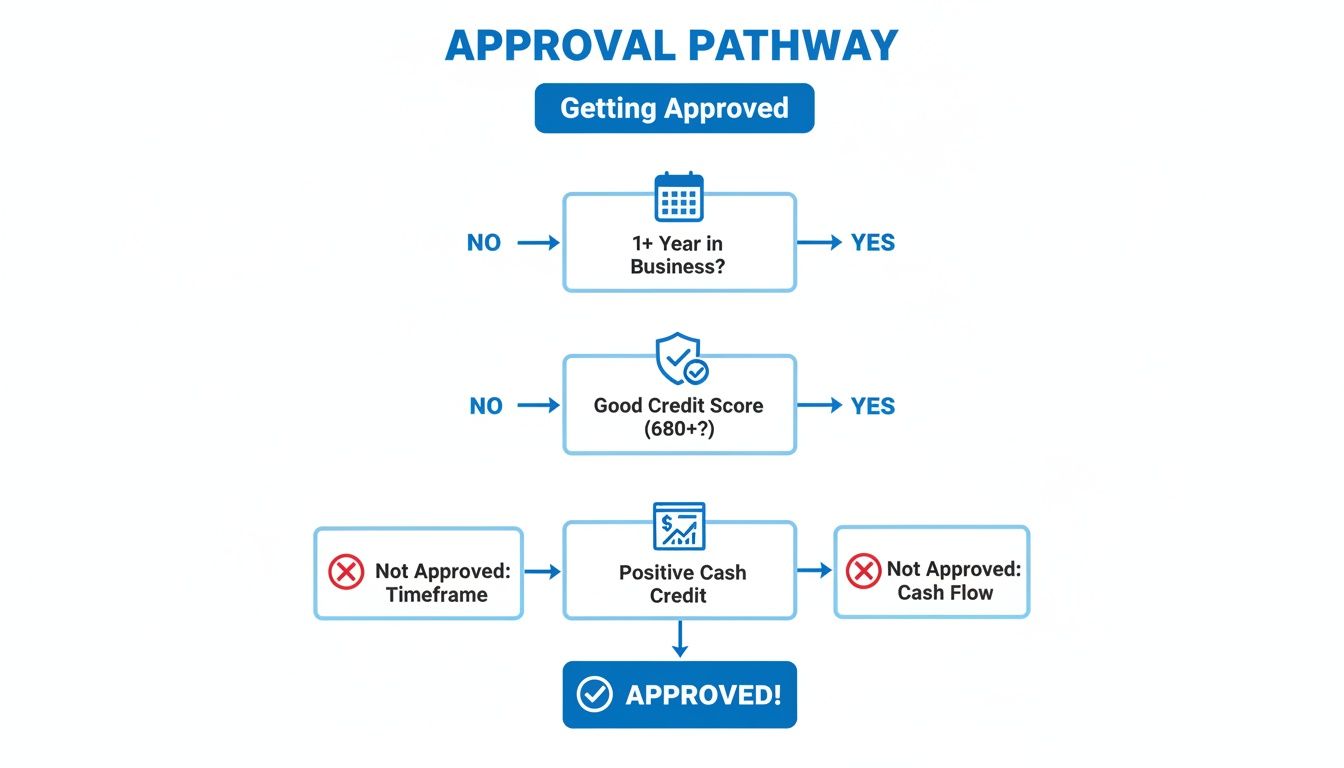
As you can see, lenders really want to see a solid track record, responsible financial habits, and consistent positive cash flow before they'll give the green light.
Line of Credit Versus Specialized Equipment Financing
Need a new excavator or bulldozer? Specialized equipment financing is almost always the smarter move. It’s a loan designed for one thing: buying heavy machinery.
Because the equipment itself acts as the collateral, you’ll typically find better interest rates and terms than if you used a general line of credit for the same purchase. You simply wouldn't use your line of credit to buy a $200,000 crane if a dedicated equipment loan offered a lower rate and a longer repayment period matched to the machine's lifespan.
Using a line of credit for major, long-term asset purchases can tie up your flexible capital. Reserve your line of credit for short-term working capital needs where its revolving nature provides the greatest advantage.
The financing world is definitely changing, too. With traditional banks tightening their belts for fifteen consecutive quarters, private credit has stepped in to fill the gap for contractors. U.S. banks' exposure to non-depository lenders has already hit $1.2 trillion. You can read more about how private credit is reshaping construction financing on ConstructConnect. This shift makes having access to a flexible line of credit from alternative sources more important than ever.
Construction Financing Comparison
To make things clearer, here’s a quick side-by-side comparison of the most common financing options for construction businesses. Think of this as a guide to help you pick the right financial tool for the right situation.
| Financing Type | Best For | Repayment Structure | Flexibility |
|---|---|---|---|
| Line of Credit | Ongoing working capital, payroll, materials, and unexpected costs. | Pay interest only on what you use; revolving access to funds. | Very High |
| Term Loan | Large, one-time investments with a known cost (e.g., buying property). | Fixed monthly payments over a set term (e.g., 5-10 years). | Low |
| Equipment Financing | Purchasing specific heavy machinery or vehicles. | Fixed payments; the equipment serves as collateral. | Low |
| Invoice Factoring | Unlocking cash trapped in unpaid invoices from creditworthy clients. | An advance on invoice value, repaid when the client pays. | Moderate |
Each of these has a distinct role. A line of credit provides operational agility, while the others offer targeted solutions for specific, well-defined financial needs. Knowing when to use each is key to smart financial management.
Common Mistakes to Avoid
A construction business line of credit can be a game-changer for growth, but you have to use it with discipline. It’s all too easy to start treating it like a bottomless cash reserve, but mismanaging it can create far more financial stress than it solves. The contractors who get the most out of their credit lines don’t see them as loans, but as strategic assets for smoothing out the natural boom-and-bust cycles of cash flow.
To turn this financial tool into a real competitive advantage, you need to steer clear of a few common pitfalls. It all comes down to understanding what a line of credit is for—and what it’s not. Smart management builds stability, not just a mountain of debt.
Using It for the Wrong Purchases
The most common mistake we see is using a short-term tool to solve a long-term problem. A line of credit is built for the ebbs and flows of working capital. Think covering payroll while waiting on a draw, buying materials for a job you just started, or bridging the gap until a delayed invoice gets paid.
It is absolutely not meant for buying a new office building or a $250,000 excavator.
When you use your flexible credit line for a major, long-term asset, two bad things happen:
- It locks up your available credit, so you have no safety net left for genuine short-term needs or emergencies.
- You almost always pay a higher interest rate than you would with specialized financing, like an equipment loan designed specifically for that kind of purchase.
A line of credit should work like a revolving door for your cash flow. You pull funds for a specific, short-term project need, then you pay that balance right back down as soon as the check for that project clears.
Get in the habit of tying every draw directly to incoming project revenue. That discipline is what keeps your line of credit available for the next cash flow crunch instead of letting it turn into another source of long-term debt.
Maxing Out Your Credit Limit
Another critical error is running your credit line all the way up to the limit without a clear and immediate plan to pay it down. Maxing out your line of credit completely wipes out your financial buffer, leaving your business exposed to any unexpected costs or project delays. A sudden equipment breakdown or a spike in material prices could throw you into a serious crisis with no cash reserves to lean on.
This is especially dangerous right now. With construction costs still hovering around 27% above pre-pandemic levels, cash flow is already a huge challenge. Builders are leaning on credit lines more than ever to handle project overruns, and tight credit conditions are affecting builders on Eye on Housing.
Think of your credit limit like a fire extinguisher: it’s there for an emergency, but you hope you never have to use all of it. Keeping a healthy cushion gives you the flexibility you need to handle the day-to-day chaos of the construction world.
Ignoring the Fine Print
Finally, remember that a line of credit isn't free money. It comes with its own set of fees and interest rules that you absolutely have to understand inside and out. Overlooking these details can lead to surprise costs that silently chew away at your profit margins.
Before you ever draw a single dollar, get clear answers to these questions:
- The Interest Rate: Is it fixed or does it change? How often is interest calculated?
- Draw Fees: Is there a fee every time you pull money from the line?
- Maintenance Fees: Do you have to pay an annual or monthly fee just to keep the line open, even if you never use it?
- Repayment Terms: Are your payments interest-only for a while, or are you paying down the principal from day one?
When you know exactly what your line of credit costs, you can use it far more effectively. This knowledge lets you make smart decisions and ensures this powerful financial tool is actually working for your business, not against it.
Frequently Asked Questions
When you're running a construction business, financing questions come up all the time. Let's tackle some of the most common ones we hear from contractors about getting a business line of credit. My goal here is to give you straightforward answers to help you decide if this is the right move for your company.
How Much Can My Construction Business Actually Get?
That's the big question, isn't it? There’s no magic number, because the credit limit is really a reflection of your business's financial health. A lender’s main focus will be on your annual revenue, the consistency of your cash flow, and your overall credit profile.
For most small and mid-sized construction outfits, lines of credit typically fall somewhere between $10,000 and $250,000. The stronger your numbers, the higher you can go. Lenders get comfortable when they see consistent, healthy monthly deposits rolling in. A business that can prove it has predictable revenue is always going to qualify for more capital.
Think of it this way: your approved credit limit mirrors your company's proven ability to make and manage money. Lenders need to see that solid foundation before they'll offer a flexible credit tool.
I'm New to Business. Can I Still Qualify?
This is a tough spot for many new construction companies. The reality is, most lenders want to see at least one full year in business. That history shows them you’ve made it past the initial startup chaos and have a foothold in the market.
But don't count yourself out just yet. If you're close to that one-year mark and can show deep industry experience or surprisingly strong early revenue, some lenders will bend the rules. It never hurts to ask, especially since some financing partners are known for working with promising young companies that have solid cash flow right out of the gate.
How Is This Different from a Regular Bank Loan?
The key difference is all about flexibility. A traditional bank loan is a one-and-done deal: you get a lump sum of cash for a specific purpose and start paying it back immediately with fixed monthly payments.
A construction business line of credit is completely different. It’s more like a financial safety net you can tap into as needed.
- Use It When You Need It: You can draw funds anytime you have a cash gap, right up to your credit limit.
- Pay for What You Use: You only pay interest on the money you've actually drawn, not the entire credit line.
- It’s Reusable: As you pay back what you've borrowed, your available credit goes right back up, ready for the next time.
This model is almost perfectly built for the up-and-down nature of the construction world, where you're constantly juggling ongoing costs, not just making one big purchase.
What Paperwork Do I Need to Apply?
You'll be happy to hear the application is far less painful than a typical bank loan. While every lender is a little different, the core documents they need are pretty standard and are all designed to give them a quick, clear snapshot of your business's stability.
Generally, you should be ready to provide:
- A simple one-page application.
- Your last 3-6 months of business bank statements.
- A copy of your driver's license to verify who you are.
And that's usually all it takes. Your bank statements are the most critical piece because they allow lenders to verify your revenue and cash flow in minutes.
Ready to see what funding options are on the table for your construction business? At FSE - Funding Solution Experts, our advisors can walk you through offers from over 50 lenders to pinpoint the best line of credit for your company. The application takes minutes, and you can get the flexible capital needed to keep your projects on track. Get started on our website and see what you qualify for.