
When you sell physical products, inventory is the lifeblood of your business. But it's also a constant cash flow puzzle. Inventory loans are a specific type of funding designed to solve this exact problem, giving you the capital to buy the products you need to sell.
Think of it as a dedicated credit line just for your stock. It allows you to prepare for a busy season or jump on a great deal from a supplier without siphoning cash away from your day-to-day operations. It’s a tool that helps you turn your biggest expense into your most powerful asset.
Why Inventory Loans Are a Business Game Changer
For retailers, e-commerce brands, or even construction companies, your inventory is a double-edged sword. It’s your primary source of revenue, but it also ties up a massive amount of cash. Finding the right balance is tricky. If you don't order enough, you're looking at empty shelves and frustrated customers. But if you order too much, all your working capital is just sitting there, unable to fund marketing, cover payroll, or fuel other growth plans.
This is where loans for inventory come in. They aren't just another form of debt; they're a strategic lever you can pull. This financing separates your buying power from your immediate cash on hand, freeing you up to make smarter, more profitable inventory decisions.
Turning Challenges into Opportunities
This kind of funding becomes incredibly valuable in a few key situations that almost every product-based business runs into. It gives you the confidence to handle unpredictable customer demand and navigate a shaky supply chain.
Here are a few moments when inventory financing really shines:
- Seasonal Demand Spikes: Getting ready for Black Friday or the holiday rush means buying inventory months ahead of time. A loan gives you the cash to stock up properly without squeezing your finances during the slower months leading up to the peak.
- Bulk Purchase Discounts: Suppliers love big orders, and they often reward them with steep discounts. This financing lets you seize those opportunities, which can significantly boost your profit margin on every single sale.
- Supply Chain Disruptions: Worried about shipping delays or rising material costs? Sometimes, the smartest move is to buy extra stock as a buffer. An inventory loan provides the agility to build that safety net and insulate your business from nasty surprises.
At the end of the day, inventory financing changes how you view your stock. It stops being a potential liability and becomes a dynamic tool for growth. It helps you get the right products on your shelves at the right time, so you can meet customer demand and grow your revenue—all while keeping your core operations financially sound.
Navigating the Different Types of Inventory Financing
Choosing the right funding for your inventory is a bit like picking the right tool for a job. You wouldn't use a sledgehammer to hang a picture, and similarly, the wrong financing can create more problems than it solves. Not all loans for inventory are built the same, so getting a handle on the key differences is the first real step toward a smart financial decision for your company.
The financing world offers a few distinct paths, each tailored to different business situations. From a one-off cash injection to a flexible credit source you can use over and over, the best choice really comes down to your goals, your sales cycle, and the nature of your inventory needs.
This simple flowchart helps visualize the core decision.
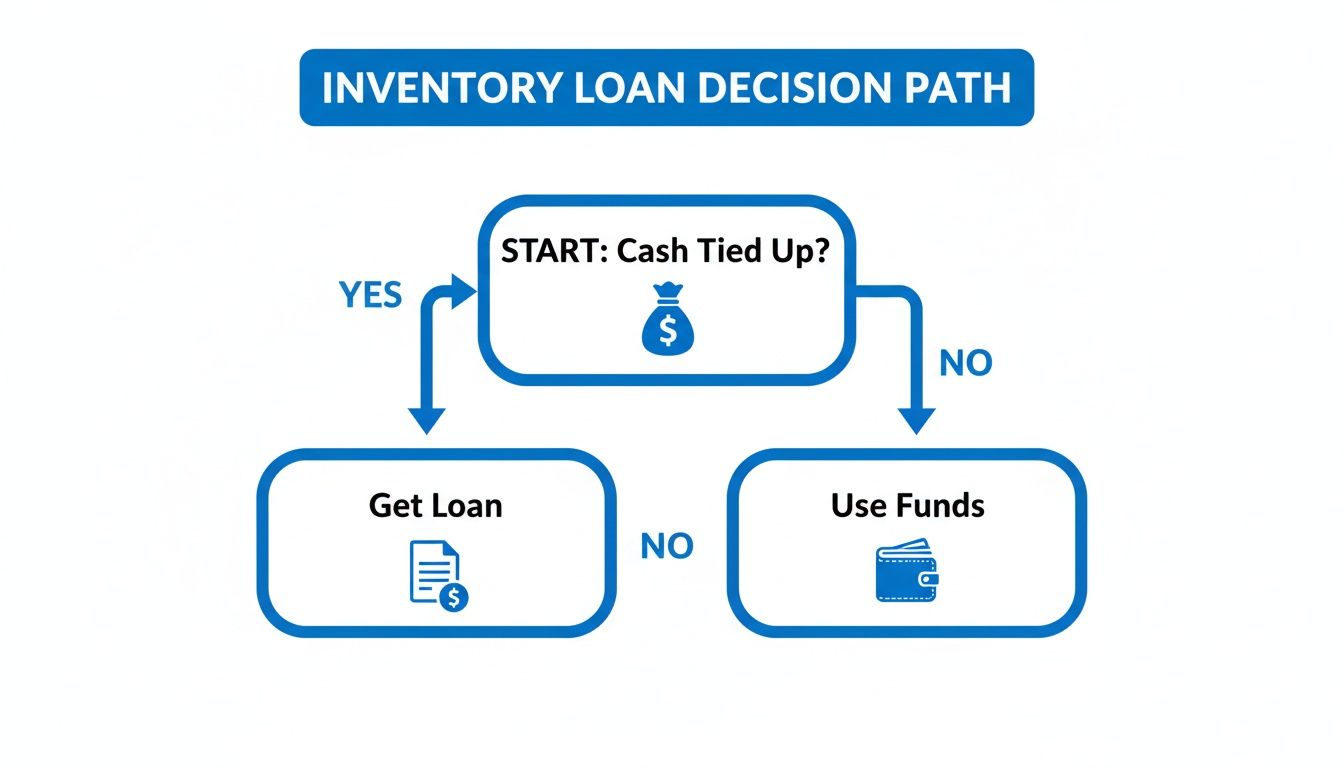
When cash flow is tight but opportunity is knocking, a loan can be the bridge that gets you from where you are to where you want to be—with a warehouse full of products ready to sell.
The Traditional Inventory Loan
Think of a traditional inventory loan as a straightforward, one-time capital injection. A lender gives you a specific lump sum of money, you use it to purchase a big batch of inventory, and then you pay it back (plus interest) in regular installments over a set term. It’s clean and simple.
This option is perfect for businesses with predictable, large-scale inventory needs. For instance, a seasonal retailer gearing up for the holidays knows they need to place a massive order in late summer. An inventory loan gives them the exact capital required for that single, significant purchase.
The main drawback? It's a one-and-done deal. Once you pay it off, the loan is closed. If another big opportunity pops up, you’re back to square one, filling out a new application.
The Flexible Inventory Line of Credit
An inventory line of credit works a lot more like a business credit card that’s specifically for buying stock. Instead of a single lump sum, you’re approved for a maximum credit limit that you can tap into whenever you need it. The best part is you only pay interest on the money you’ve actually drawn, not the entire credit line.
This structure provides incredible flexibility, especially for businesses with fluctuating or continuous inventory demands. Picture an e-commerce store that has to constantly restock its best-sellers. With a line of credit, they can make smaller, more frequent purchases without the hassle of reapplying for funding every time.
A key feature of a revolving line of credit is its reusability. As you repay what you've borrowed, that credit becomes available again, creating a dependable capital well for ongoing inventory management.
Purchase Order Financing for Specific Orders
Purchase order (PO) financing is a very specialized tool for a common problem: you land a huge, confirmed purchase order from a customer but don't have the cash on hand to actually produce or acquire the goods to fulfill it.
Here's how it works: a PO financing company steps in and pays your supplier directly. Once your supplier delivers the goods to your customer, the customer pays the financing company. The financer then deducts its fees and sends you the remaining profit.
This isn’t a loan in the traditional sense; it’s a transactional funding solution. It’s a lifesaver for wholesalers, distributors, and any business that deals with large B2B orders but can’t afford to have its own cash tied up in production.
Merchant Cash Advance: A Sales-Based Approach
A merchant cash advance (MCA) flips the script entirely. A lender provides an upfront sum of cash in exchange for a percentage of your future daily or weekly credit card sales. Your repayment isn't on a fixed schedule—it ebbs and flows with your revenue.
This can be a great fit for businesses with high-volume daily sales, like a busy cafe or a popular retail shop. If you have a slow week, your repayment is smaller. If sales are booming, you pay back more. Here, your future sales are the collateral, not the inventory itself.
While MCAs are fast and accessible, they are almost always more expensive than traditional loans. It’s critical to understand the total cost, as they use a "factor rate" instead of a standard APR. This option is all about prioritizing speed over cost.
To help you see these options side-by-side, we've put together a quick comparison table. This should make it easier to see which financing type might be the best match for your business.
A Quick Comparison of Your Financing Options
| Financing Type | Best Suited For | Repayment Structure | Typical Funding Speed |
|---|---|---|---|
| Inventory Loan | Large, one-time seasonal or bulk purchases. | Fixed monthly payments over a set term. | 1-4 weeks |
| Inventory Line of Credit | Ongoing, fluctuating inventory needs and managing cash flow. | Pay interest only on funds used; repay and reuse. | 1-3 weeks |
| Purchase Order Financing | Fulfilling a large, confirmed customer order without upfront capital. | Customer pays financer; you receive the profit minus fees. | 1-2 weeks |
| Merchant Cash Advance | Quick cash for businesses with strong daily sales volume. | A percentage of future daily/weekly sales. | 24-72 hours |
Each of these tools has a clear purpose. An inventory loan is for a single, planned event, while a line of credit is for managing the day-to-day. PO financing solves a specific fulfillment gap, and an MCA offers pure speed when you need cash immediately.
What Lenders Are Really Looking For
Getting an inventory loan isn't some black-box process. Lenders aren't trying to trip you up; they're simply trying to understand your business's health and, most importantly, your ability to turn that inventory into cash. If you know what they're looking for ahead of time, you can walk into the conversation ready to make a strong case.

While the specifics can vary from one lender to the next, the core principles are almost always the same. They’re looking for a clear picture of your operational track record and financial stability.
Foundational Eligibility Benchmarks
Before a lender even starts digging into your financials, they'll run a quick check to see if you meet their basic, non-negotiable criteria. Think of it as the first gate you need to pass through. It's their way of quickly filtering for businesses with a certain level of maturity and activity.
Here's what they typically want to see right off the bat:
- Time in Business: Most lenders want to see at least one year of history. This tells them you’ve navigated the tricky startup phase and your business model has some staying power.
- Monthly Revenue: A minimum of $10,000 in monthly revenue is a common benchmark. Consistent sales prove you have a real market and the cash flow to manage loan payments.
- Personal Credit Score: Even though alternative lenders are more forgiving than big banks, a FICO score of 600 or higher is often the baseline. It’s a quick gut check on your financial reliability.
Clearing these initial hurdles gets your application in the door. Now, it's time to prove your business is as solid as those numbers suggest.
The Key Documents and What They Reveal
This is where the real story gets told. The documents you submit give a lender a direct look under the hood of your business, showing them exactly how money moves in and out.
Lenders aren't just looking at numbers on a page; they're looking for proof of a healthy, functioning business that can successfully manage and sell its inventory. A well-prepared application makes their decision easy.
Here’s the essential checklist of what you'll need and why it matters:
- Recent Bank Statements (3-6 Months): This is the single most important document. It’s where lenders verify your revenue, look for stable cash flow, and check for red flags like frequent overdrafts. A healthy daily balance is a huge plus.
- Inventory Records: You'll need to provide a detailed list of your current stock—what you have, how much you have, and what you paid for it. This helps the lender understand the value of the collateral that’s securing their loan.
- Supplier Invoices or Purchase Orders: These documents show the lender precisely how you plan to use their money. It confirms the funds are going directly toward purchasing new, sellable products.
Demand for this kind of financing is robust, particularly as companies work through supply chain and market shifts. In fact, overall loan growth has been surprisingly strong, and inventory financing is a big part of how U.S. businesses are managing their working capital. This is especially true for businesses in retail, construction, and hospitality, where alternative lenders are stepping in to provide the funding traditional banks can't. You can read more about these trends in a recent report from S&P Global on loan growth estimates.
A Step-By-Step Guide to the Application Process
Getting a loan for your inventory might seem daunting, but it's a lot more straightforward when you know what to expect. Modern funding partners have streamlined the entire process, focusing on speed and clarity so you can get back to running your business.
From the first click to cash in your bank account, each step is designed with a clear purpose, eliminating the weeks of waiting you'd typically face with a traditional bank.
Instead of getting lost in a maze of paperwork, you'll work with a dedicated funding advisor. Think of them as your personal guide, making sure you move from one stage to the next without a hitch.
Step 1: Submitting the Initial Application
This first step is usually the easiest part. You'll fill out a short online form that takes just a few minutes, providing the basics: your name, company name, how long you've been in business, and average monthly revenue.
This isn't a full financial deep-dive. It’s more like a quick handshake—a preliminary check to see if your business generally fits the lender's profile. You're simply raising your hand to say, "I'm interested and I meet the basic qualifications."
Step 2: Consulting with a Funding Advisor
After you submit the form, a funding advisor will reach out. This is where the real value kicks in. Their job is to understand exactly what you need. Are you trying to stock up for the holiday rush? Or did a supplier just offer you a killer bulk discount you can't pass up?
With that context, they'll tap into their network of lenders to find the best offers for your specific situation. It completely flips the script—instead of you hunting down lenders one by one, the best options are brought directly to you.
Step 3: Providing Your Documentation
Once you've spoken with your advisor, you'll need to supply the necessary documents, which are usually just your most recent bank statements. The process is designed to be fast and secure, allowing you to upload everything digitally.
No printing, no mailing, no driving to a branch. This is one of the biggest reasons why getting loans for inventory is so much faster now.
Step 4: Navigating Underwriting and Approval
With your documents in, the lender's underwriting team gets to work. This is the due diligence phase where they verify your revenue and assess your business's financial health to finalize the loan terms.
Your funding advisor stays in the loop the whole time, acting as your liaison. They'll answer any questions the underwriter has and keep you updated, preventing the small delays that can otherwise stall an application.
The modern application process prioritizes speed without sacrificing diligence. By using technology and dedicated advisors, what once took weeks can now be completed in just a couple of business days.
Step 5: Receiving Your Funds
Once approved, you’ll get a clear, easy-to-understand offer detailing the loan amount, interest rate, and repayment terms. As soon as you review and accept it, the funds are on their way.
This is where you'll really appreciate the speed. In most cases, the money is deposited directly into your business bank account in as little as 24 to 48 hours. That kind of rapid access means you can jump on inventory opportunities the moment they appear, turning a potential funding headache into a real competitive edge.
How Different Industries Win with Inventory Loans
The idea of inventory financing can seem a bit theoretical until you see it in the real world. In practice, loans for inventory are incredibly powerful tools that businesses across all sorts of industries use to solve very real problems. They can be the fuel for growth, a buffer against unexpected bumps in the road, or the key to seizing a golden opportunity.
Let's walk through a few common scenarios to see how smart companies turn inventory headaches into major wins.

These examples show the direct impact that the right funding can have, whether you're stocking retail shelves, buying raw construction materials, or prepping for a restaurant's seasonal rush.
E-commerce Prepares for Peak Season
An online retailer that sells outdoor gear faces the same crunch every single year. Their biggest sales driver is the Black Friday and holiday shopping season, but to be ready, they have to place massive orders for jackets, tents, and boots way back in late summer. This means tying up a huge chunk of cash months before any revenue comes in.
- The Challenge: Draining their operating account for this huge purchase would leave them with nothing for marketing, payroll, or any unexpected costs during the critical Q3 and Q4 build-up.
- The Solution: They secure a short-term inventory loan. This gives them a lump sum of capital specifically to pay their suppliers for all that holiday stock, leaving their daily operating cash untouched.
- The Result: The retailer is fully stocked and primed for the holiday rush. They also have plenty of capital left to run aggressive marketing campaigns, which helps them achieve a 25% increase in holiday sales over the previous year. Once the sales roll in, they pay back the loan with ease.
Construction Locks in Better Material Prices
Imagine a mid-sized construction company that just won a contract for a large residential development. They know the price of lumber and other building materials is all over the place and likely to go up over the next six months. If they could buy everything they need upfront, they could lock in today's lower prices and protect their profit margin.
- The Challenge: Coming up with that much cash at once would completely strain their cash flow. It would also tie their hands, preventing them from bidding on other promising jobs.
- The Solution: They open an inventory line of credit. This gives them the flexibility to draw funds whenever they need to make bulk material purchases, allowing them to buy when prices are most favorable.
- The Result: The company ends up saving over $80,000 in material costs by getting ahead of price hikes. Not only does this make the project more profitable, but it keeps their operational cash free for labor and equipment rentals, enabling them to take on a second project at the same time.
This kind of strategic buying is crucial. A recent survey from The Hackett Group found that a staggering $1.7 trillion—or 35% of gross working capital—was stuck in inventory at top U.S. firms. Access to fast funding helps businesses in construction, retail, and logistics free up that capital and put it to work.
When you treat inventory financing as a strategic tool, you can transform a major expense into a true competitive advantage, protecting your margins and paving the way for growth.
A Restaurant Capitalizes on a Seasonal Menu
A farm-to-table restaurant owner wants to launch a special summer menu built around locally sourced ingredients. To get the best quality and price, she needs to buy produce, meats, and other goods in bulk from local farms right at the start of the season.
- The Challenge: Making these large upfront purchases would clean out the restaurant’s cash reserves, which are essential for daily operations and staffing during the busy summer tourist months.
- The Solution: She decides on a merchant cash advance (MCA). She gets a quick injection of cash to buy all her seasonal ingredients and pays it back through a small, fixed percentage of her daily credit card sales.
- The Result: The seasonal menu is a huge success, bringing in new customers and boosting the average check size. Because the MCA repayment is tied directly to her sales, the payments are higher on busy weekends and lower on slow weekdays, moving in perfect sync with her cash flow. The profits from the new menu easily cover the cost of the financing.
Choosing the Right Funding for Your Business Needs
Now that you have a solid grasp of the different financing options, it's time to pick the one that fits your business perfectly. This is about more than just chasing the lowest interest rate. The right choice aligns the funding with your company's operational rhythm and where you want to be in the future. A few key questions can help light the way.
Taking the time to think through this ensures the loans for inventory you get are a strategic asset, not just a quick fix. A smart decision now prevents cash flow headaches down the road and sets you up for steady growth.
One-Time Purchase or Ongoing Need?
First, what’s the nature of your inventory need? Are you gearing up for a single, massive order, or do you need a constant flow of capital to keep your shelves stocked?
- For a one-time event, like loading up for the holiday rush or jumping on a huge bulk discount, a traditional inventory loan is usually the simplest path. You get a lump sum for a specific purpose and have a clear, predictable repayment plan.
- For ongoing needs, like consistently replenishing your top sellers, an inventory line of credit is far more flexible. Think of it as a financial resource you can draw from and repay as needed, only paying interest on the funds you actually use.
How Fast Is Your Cash Flow Cycle?
Next, look at how quickly you turn your products into profit. A business selling thousands of low-cost items every week has a much faster cash conversion cycle than a company selling high-end luxury goods that might sit for months.
The speed of your sales cycle should dictate your repayment terms. If your inventory moves fast, you can handle more frequent payments, similar to what you’d find with a merchant cash advance. But if it takes 90 days to sell a product, a term loan with predictable monthly payments makes a lot more sense.
The goal is to match your repayment obligations to your revenue stream. A mismatch can create significant pressure, turning a helpful loan into a financial burden. Don't borrow on a 30-day cycle if it takes 90 days to sell the product.
What Is the True Cost of Capital?
Interest rates are just the headline number. To make a truly informed decision, you have to look at the total cost of capital, which includes every single fee. Lenders often have origination fees to set up the loan or appraisal fees to determine the value of your inventory.
Always request a complete breakdown of costs to understand the Annual Percentage Rate (APR). The APR gives you an apples-to-apples way to compare different offers and see the real price tag. It's not uncommon for a loan with a lower interest rate but high fees to be more expensive than one with a slightly higher rate and nothing extra tacked on.
The importance of this kind of financing is hard to overstate. Global supply chain finance volume recently hit an incredible USD 2,462 billion—an 8% jump in just one year. This shows just how critical it is for businesses trying to manage inventory in unpredictable markets. For small and mid-sized U.S. companies, this funding is an absolute lifeline. You can dive deeper into these trends in the World Supply Chain Finance Report by Citi.
Got Questions? We’ve Got Answers.
Even after laying out the options, you probably have a few practical questions about how loans for inventory really work. That's completely normal. Getting clear answers is the best way to feel confident about finding the right funding for your business.
Let's dive into some of the most common questions we hear from business owners just like you.
"My Credit Isn't Great. Can I Still Get an Inventory Loan?"
Absolutely. While a big bank might fixate on your FICO score, many modern lenders look at the bigger picture. They're more interested in the health and performance of your business itself.
What they really care about are things like your consistent monthly revenue and how long you've been in business. Think of it this way: a credit score is just one part of your financial story. Strong, reliable cash flow often tells a much more compelling story about your ability to handle a loan, opening doors that might have otherwise been closed.
The bottom line for a lender is simple: can your business sell the inventory you're buying? If you have a track record of consistent sales, that can easily outweigh a less-than-perfect credit score. It proves your business model works, and that's what matters most.
"How Much Can I Actually Borrow?"
The amount you can borrow is usually tied directly to the value of your inventory. Lenders will typically offer a loan amount that's somewhere between 20% to 65% of your inventory's appraised value. But that’s not the only number they look at.
They'll also want to see your recent bank statements to confirm your monthly revenue. This two-part check ensures you not only have a valuable asset (your inventory) but also the steady cash flow needed to make your payments without straining your operations. The final offer will be a number that both the value of your stock and the strength of your sales can comfortably support.
"What If I Don't Sell All the Inventory?"
This is a huge, valid concern, and it's a risk lenders are very familiar with. No lender wants you to default because of slow-moving products. That's why finding a loan structure that matches your natural sales cycle is so critical.
The best financing options have some built-in flexibility. For example:
- An inventory line of credit is perfect for this. You only draw funds as you need them, so you aren't under pressure to sell off one massive shipment all at once.
- A merchant cash advance ties your payments to your daily sales. If you have a slow week, your payment is smaller. It adjusts automatically.
Before you sign anything, have an honest conversation with your funding advisor about this "what if" scenario. The goal is to choose a loan with terms that reflect the reality of your sales patterns. That way, your financing remains a powerful tool for growth, not a source of stress.
You don't have to figure all this out alone. At FSE - Funding Solution Experts, our advisors get to know you and your business. We then tap into our wide network of lenders to find the perfect match for your specific situation. We handle the hard part—finding the answers and the funding—so you can get back to what you do best. Apply today and get the capital you need in as little as 24 hours.