Ever wonder what lenders really look at when you apply for a business loan? It often boils down to one critical number: the Debt Service Coverage Ratio (DSCR).
In the simplest terms, DSCR is a financial stress test. It’s designed to answer one fundamental question that every lender has: “Does this business actually generate enough cash to pay back its debts?”
What DSCR Is and Why It Matters

Think of your business's cash flow as the water level in a reservoir, and your total debt payments as the dam holding it back. The DSCR is the measurement that tells a lender whether the water level is high enough to be safe, or if it's dangerously low and at risk of a breach. If your cash flow dips below your debt obligations, the dam breaks—and your business could default.
This single ratio gives lenders a clear, standardized snapshot of your operational profitability against your financial commitments. For many commercial lenders, it’s the most important number in your entire loan application, often carrying more weight than your personal credit score.
Why Lenders Obsess Over DSCR
Lenders zero in on the Debt Service Coverage Ratio because it cuts through the noise and isolates the business’s ability to stand on its own two feet. Instead of getting tangled up in an owner's personal finances, DSCR focuses squarely on the company's performance.
This is especially true in industries like logistics, construction, or commercial real estate. For these types of businesses, mastering your DSCR is the key that unlocks financing.
- Cash Flow is King: The entire business model hinges on consistent operational income to cover significant debts tied to assets like trucks, equipment, or buildings.
- Personal Income is Separate: Owners often can't—or don't want to—rely on their personal income to secure a business loan.
- Asset Performance is Measurable: The income generated by a specific property or piece of heavy machinery can be calculated with precision.
To help break this down, let's look at the key components that go into the DSCR calculation.
DSCR At A Glance Key Components
| Component | What It Means | Example for a Business |
|---|---|---|
| Net Operating Income (NOI) | This is your business's total income before you've paid interest and taxes. Think of it as your pure operational profit. | Your logistics company generated $200,000 in revenue after all operating expenses (fuel, maintenance, salaries) were paid. |
| Total Debt Service | This is the sum of all your debt payments—both principal and interest—over a one-year period. | Your annual payments for truck loans and a warehouse mortgage total $160,000. |
| DSCR Ratio | The result of dividing your NOI by your Total Debt Service. This tells you how many times over you can cover your debt. | $200,000 (NOI) / $160,000 (Debt) = 1.25 DSCR. |
Understanding these pieces is the first step to seeing your business through a lender's eyes.
DSCR in Real Estate and Beyond
The Debt Service Coverage Ratio is a cornerstone of real estate investing. It’s calculated by dividing a property's net operating income (NOI) by its total annual debt payments. This ratio became a go-to metric after the 2008 financial crisis, as banks tightened standards and shifted toward loans based on property cash flow rather than an investor's personal income. You can see this emphasis in modern financing products like the DSCR loans explained by NASB.
The Bottom Line: A DSCR above 1.0 shows your business has enough income to cover its debt payments. Anything below 1.0 means you're in the red—you don't have enough cash flow to meet your obligations, which is a massive red flag for any lender.
How to Calculate Your DSCR: A Real-World Example
Figuring out your Debt Service Coverage Ratio might sound like something reserved for accountants, but it’s actually a pretty straightforward look at your company’s financial health. It all comes down to a simple formula that compares the cash you're generating to the debt payments you need to make.
The formula itself is clean and simple:
DSCR = Net Operating Income / Total Debt Service
Let's pull this out of the textbook and put it to work. We'll break down each piece of the puzzle and then walk through an example with a fictional small business to see how it all clicks together.
Step 1: Find Your Net Operating Income
First things first, you need your Net Operating Income (NOI). Think of this as the pure profit your business makes from its core operations before interest and taxes are taken out. It’s a clean look at how much cash the business itself—the day-to-day selling, making, or doing—is bringing in.
You'll find the numbers you need on your income statement. The calculation looks like this:
NOI = Gross Revenue - Operating Expenses
Remember, operating expenses are the costs of keeping the lights on—things like rent, payroll, utilities, and materials. What’s important is what you exclude: interest, taxes, depreciation, and amortization. We want the raw operational profit.
Step 2: Calculate Your Total Debt Service
Next up is your Total Debt Service. This is simply the grand total of all your debt payments for an entire year, including both the principal and the interest. You’ll need to tally up every loan payment on your books.
This includes what you pay for:
- Business term loans
- Equipment financing
- Commercial mortgages
- Payments on lines of credit
Just add up everything you're scheduled to pay on these debts over the next 12 months. That final number is your Total Debt Service.
A Real-World DSCR Calculation Example
Alright, let's see this in action. We'll use a hypothetical small trucking company, "HaulRight Logistics," that's looking to finance a new truck. Before they even talk to a lender, they need to know their DSCR to see where they stand.
HaulRight Logistics' Financials:
Calculate Net Operating Income (NOI):
- Annual Revenue: $500,000
- Operating Expenses (fuel, maintenance, salaries, insurance): $380,000
- NOI = $500,000 - $380,000 = $120,000
Calculate Total Debt Service (TDS):
- Annual payments on two existing truck loans: $60,000
- Annual payments on a warehouse loan: $30,000
- TDS = $60,000 + $30,000 = $90,000
Calculate the DSCR:
- DSCR = NOI / TDS
- DSCR = $120,000 / $90,000 = 1.33
The Result: HaulRight Logistics has a DSCR of 1.33. In plain English, this means for every $1 they owe in debt payments each year, they generate $1.33 in cash from their operations. That gives them a 33% cash buffer after all their loans are paid.
This is the number a lender will zoom in on. A DSCR of 1.33 is typically seen as solid, showing that HaulRight can comfortably handle its existing debts with room to spare. By running this calculation beforehand, the owner can walk into a meeting with a lender not just asking for a loan, but demonstrating they have the financial strength to back it up.
What Lenders Consider a Good DSCR Score
So you've run the numbers and have your Debt Service Coverage Ratio. Now what? That number is more than just a figure on a spreadsheet; it's the primary way a lender will size up your business's financial health and its ability to take on new debt. Getting it right is a huge piece of the funding puzzle.
Think of it like this: a DSCR below 1.0 is an immediate red flag. It’s a clear signal that your company isn't generating enough cash to even cover its existing debt payments. From a lender's perspective, this is a non-starter. Taking on more debt when you can't handle what you already have is a risk almost no financial institution will take.
The Magic Number for Approval
For most commercial lenders, the unofficial "safe zone" begins at a DSCR of 1.25. Hitting that number means your business brings in $1.25 for every $1.00 it needs to pay out for debt.
That extra 25% isn't just a bonus—it's a critical safety cushion. It tells a lender that you can comfortably make your payments and have enough breathing room to handle a slow sales month or an unexpected repair bill without missing a beat.
A DSCR of 1.0 is just breaking even on your debt. While you're technically covering your payments, there's zero margin for error. One small hiccup could throw your cash flow into the red, and that's a gamble most lenders aren't willing to make.
This simple diagram breaks down how your income and debt obligations come together to form this all-important ratio.
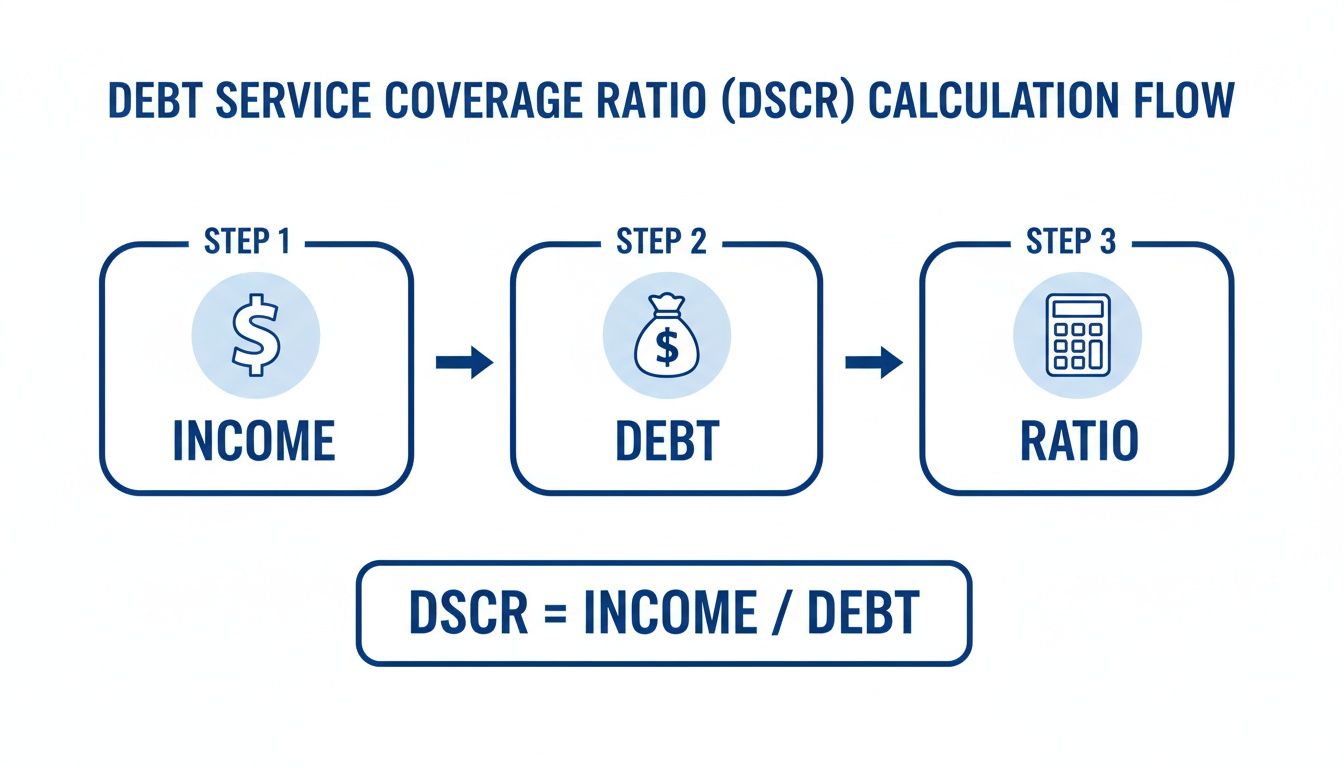
As you can see, it's a straightforward calculation, but the story it tells a lender about your business's stability is profound.
Why Industry and Loan Type Change the Rules
While 1.25 is a solid rule of thumb, it's not a universal standard. The "good" DSCR that gets you approved can shift depending on your specific situation. Lenders look at the bigger picture.
- Industry Stability: A business in a predictable sector, like a fully-occupied commercial building with long-term leases, might get a green light with a slightly lower DSCR. On the other hand, a business with more volatile revenue, such as a restaurant or a seasonal retailer, will likely need to show a stronger ratio—think 1.35 or even higher—to prove its resilience.
- Economic Climate: When the economy gets shaky, lenders get more conservative. They often tighten their standards and raise minimum DSCR requirements across the board to protect themselves from increased risk.
- Loan Purpose: What you plan to do with the money matters, too. A loan to purchase a cash-flowing asset will be viewed differently than a working capital loan meant to bridge a temporary operational gap.
The world of real estate investing offers a great example. A DSCR below 1.0 is a deal-killer. During the economic uncertainty of 2020, rising vacancies pushed 25% of U.S. commercial properties below a 1.1 DSCR. In response, many lenders quickly bumped their minimums into the 1.2-1.5 range to ensure they were only backing stable properties. This shift has also fueled the growth of the Non-QM loan market, where DSCR-based loans are helping investors qualify based on property performance rather than personal income. You can learn more about these dynamics from J.P. Morgan's real estate insights.
DSCR Lender Interpretation Guide
To help you see where you might stand, here’s a quick guide to how most lenders interpret different DSCR values. Think of it as a cheat sheet for your loan application.
| DSCR Value | Lender Interpretation | Likely Loan Outcome |
|---|---|---|
| Below 1.0 | High Risk. The business does not generate enough income to cover existing debt payments. | Almost certain decline. Lenders will not fund a business that is losing money on its debt. |
| 1.0 - 1.15 | Marginal. The business can barely cover its debts, leaving no room for unexpected costs or slow periods. | High probability of decline. Some niche lenders might consider it, but with strict terms and high rates. |
| 1.15 - 1.25 | Acceptable but Weak. This is often the bare minimum. The business has a small cushion, but is still seen as a moderate risk. | Possible approval, but with less favorable terms. Expect higher interest rates and lower loan amounts. |
| 1.25 - 1.50 | Good to Strong. This is the sweet spot for most lenders. It shows a healthy cash flow buffer. | High probability of approval. You’re likely to qualify for standard loan terms and competitive rates. |
| Above 1.50 | Excellent. A very strong financial position with significant cash flow to handle debt and unforeseen events. | Excellent chance of approval. Lenders will see you as a low-risk borrower, leading to the best possible terms and rates. |
Ultimately, a stronger DSCR not only increases your chances of getting approved but also gives you more negotiating power for better loan terms. It's one of the most direct ways to prove your business is a safe and reliable bet.
How Your DSCR Shapes Your Loan Offer
Your Debt Service Coverage Ratio isn't just another number on a spreadsheet; it’s one of the most powerful levers you can pull when negotiating a loan. A strong DSCR doesn't just open the door to getting approved—it fundamentally changes the quality of the deal you can get.
Think of it from the lender's perspective. A business that can easily cover its debt obligations is a much safer bet than one operating on razor-thin margins. That lower perceived risk translates directly into more attractive financing terms for you.
Better Ratios, Better Deals
Let's imagine two similar businesses are applying for the same loan. The first has a healthy DSCR of 1.6, while the second just barely makes the cut with a 1.2. Both might get approved, but the terms they're offered will be worlds apart.
The business with the 1.6 DSCR is in the driver's seat and will likely secure:
- Lower Interest Rates: Lenders compete for low-risk borrowers. A strong ratio means you'll command better rates, which can save you a significant amount of money over the life of the loan.
- Higher Loan Amounts: When your cash flow shows a comfortable buffer, lenders gain the confidence to extend more capital, fueling your growth plans.
- Flexible Repayment Schedules: You might be offered longer repayment periods, which can reduce your monthly payments and free up cash for operations.
This is where your DSCR shifts from being a simple metric to a strategic tool for securing the best possible financing.
A Game Changer in Commercial Lending
In the world of commercial financing, DSCR-focused loans have been a genuine game changer. These loans allow lenders to focus almost entirely on the property's ability to generate income, rather than on the borrower's personal credit history or tax returns.
This is a massive advantage, especially considering that 29% of U.S. small businesses were denied traditional bank loans in 2023. For these loans, lenders typically look for a DSCR between 1.0 and 1.5. A ratio of 1.25, for instance, tells them the property's net income can cover the debt service with a solid 25% cushion. You can learn more about how these DSCR business purpose loans from Griffin Funding are creating new pathways to capital.
Key Takeaway: A higher DSCR is your leverage. It demonstrates financial strength, reduces the lender's risk, and puts you in a position to get better rates and terms. It's the difference between just getting a loan and getting the right loan.
Actionable Strategies to Improve Your DSCR

Knowing your Debt Service Coverage Ratio is one thing, but actively improving it is where the real power lies. A strong DSCR doesn't just get your foot in the door for a loan; it puts you in a position to negotiate for better rates and more favorable terms. The best part? You don't need complex financial wizardry to move the needle.
It really boils down to a straightforward, two-part strategy: grow your Net Operating Income (NOI) and shrink your Total Debt Service. By focusing your efforts on these two levers, you can systematically build a healthier financial profile that lenders will see as a much lower risk.
Boosting Your Net Operating Income
The most direct path to a better DSCR is to increase the cash your business brings in. This isn't just about chasing massive sales growth; it’s about smart, sustainable adjustments that improve your profitability. Think of it as widening the gap between what you earn and what you spend to keep the lights on.
Here are a few practical ways to get started:
- Review and Adjust Pricing: Can your market absorb a small price increase? Even a modest bump of 2-3% often drops straight to your bottom line without scaring away customers.
- Trim Non-Essential Costs: Take a hard look at your operating expenses. It's amazing what you can find—unnecessary subscriptions, wasteful overhead, and inefficient processes that quietly drain your cash flow.
- Renegotiate Supplier Contracts: Loyalty is important, but your business's health comes first. Talk to your key vendors about better pricing, volume discounts, or more flexible payment terms. A simple phone call can sometimes save you thousands.
Key Insight: Improving your DSCR starts with operational discipline. Every dollar you add to revenue or shave from expenses directly strengthens your Net Operating Income, making your business far more attractive to a lender.
Reducing Your Total Debt Service
The other side of the DSCR coin is your total debt obligation. Lowering this number can be just as impactful as boosting your income because it reduces the fixed financial load your company has to carry every month. This is all about making your debt load more manageable.
Your main objective here is to lower your total annual payments, which immediately frees up cash and gives you more breathing room.
Strategic Debt Reduction:
- Refinance High-Interest Loans: If you're carrying debt with high interest rates, refinancing could be a game-changer. Securing a new loan with a lower rate can slash your monthly payments and give your DSCR a significant lift.
- Consolidate Multiple Debts: Juggling payments for multiple loans is often inefficient and expensive. Rolling several smaller debts into one larger, consolidated loan can simplify your finances and frequently lowers your total monthly outlay.
- Pay Down Principal on Existing Debt: If you find yourself with extra cash, use it strategically. Making extra payments against the principal on your most expensive debt is a powerful move that reduces future interest and shrinks your Total Debt Service faster.
When you tackle both income and debt with this kind of focus, you take control of your company's financial story. It shows lenders that you're not just managing your business—you're actively strengthening it for stable, long-term growth.
Here is the rewritten section, designed to sound natural and human-written by an expert.
Where Do You Go From Here? Partnering Up for DSCR Financing
Okay, so you’ve calculated your DSCR and you know your numbers are solid. That’s a fantastic start, but it's often just the first step on a long road. The real challenge? Finding a lender who sees your business for what it is: a healthy, cash-generating operation, not just a set of numbers on a spreadsheet.
It’s a frustratingly common story. A business with great cash flow gets a hard "no" from a traditional bank because of rigid, cookie-cutter lending criteria. This is exactly where bringing in a strategic financing partner can completely change the game.
Instead of spending weeks, or even months, trying to find the right lender on your own, an expert can connect your strong performance directly with the right source of capital. It takes the guesswork out of the equation and significantly boosts your odds of not just getting approved, but getting terms that actually work for your business.
An Advocate on Your Side of the Table
At Funding Solution Experts (FSE), we live and breathe this stuff. We're not just brokers; we're advocates who guide businesses like yours through the often-confusing world of lending. Our entire model is built around a simple idea: strong cash flow should unlock great financing.
We’ve spent years building a network of over 50 lenders who specifically focus on DSCR-based financing. They get it. They understand that a business's health isn't always reflected in a perfect credit score or years of flawless financials.
Our lending partners know the ins and outs of industries that live and die by cash flow, including:
- Trucking and logistics
- Construction and home services
- Restaurants and hospitality
Our goal is straightforward: we make sure your strong cash flow translates into the fast, flexible capital you need to grow. We'll cut through the jargon, lay out your options clearly, and connect you with financial partners who value your business's real-world performance.
Think of it this way: instead of going from bank to bank hoping someone understands your story, you get an expert who already knows who to talk to and how to present your case. We help turn your solid DSCR from just a ratio into your most powerful tool for securing capital.
DSCR FAQs: Your Questions Answered
As you get more comfortable with DSCR, you'll naturally start to wonder about the finer points. We've been there. Here are some straightforward answers to the questions we hear most often from business owners navigating the financing process.
So, Can I Get a Loan With a DSCR Under 1.0?
Let's be direct: getting a standard business loan with a DSCR below 1.0 is a tough sell. A number that low is a major red flag for lenders. It tells them your current cash flow isn't even enough to cover your existing debt payments, making any new loan a significant risk.
That said, it’s not always a dead end. Some alternative financing, like a merchant cash advance or asset-based lending, might still be on the table. These products focus more on your future sales or the value of your collateral rather than your past cash flow performance. Just be aware that they almost always come with higher costs and more aggressive terms. The smartest move is always to focus on boosting your DSCR before you apply for new credit.
Is DSCR a Big Deal for Every Single Business Loan?
While DSCR is king for many loans, it doesn't always take center stage. Its importance really hinges on the type of financing you're after.
- Absolutely Critical For: Think commercial real estate, heavy equipment financing, and most conventional term loans. For these, the lender's number one question is, "Can your business generate enough cash to make the monthly payments?" Your DSCR is the direct answer.
- Not Always the Main Event For: When you're looking at certain SBA loans or a flexible line of credit, lenders often take a more holistic view. They might put just as much, if not more, emphasis on your personal credit history, how long you've been in business, and the overall financial picture.
Expert Tip: Don't guess what a lender wants to see. Ask them directly what metrics they weigh most heavily. Knowing if they prioritize DSCR, personal credit, or collateral value lets you build the strongest possible application right from the start.
How Often Should I Be Checking My DSCR?
The worst time to calculate your DSCR is right when you're filling out a loan application. You should treat it as a vital health metric for your business.
We advise our clients to run the numbers at least once a quarter. This gives you a regular pulse check on your financial standing and helps you spot negative trends long before they turn into serious problems. Consistent tracking empowers you to make smarter, more confident decisions about everything from managing expenses to seizing the right growth opportunities.
Trying to make sense of your DSCR and match it to the right lender can feel overwhelming. At FSE - Funding Solution Experts, this is what we do all day. Our team specializes in helping businesses with strong cash flow tell their financial story to our network of over 50 lenders. We’ll help you put your best foot forward and connect you with the capital you need to grow.
Find out how we can help your business at https://www.fseb2b.com.